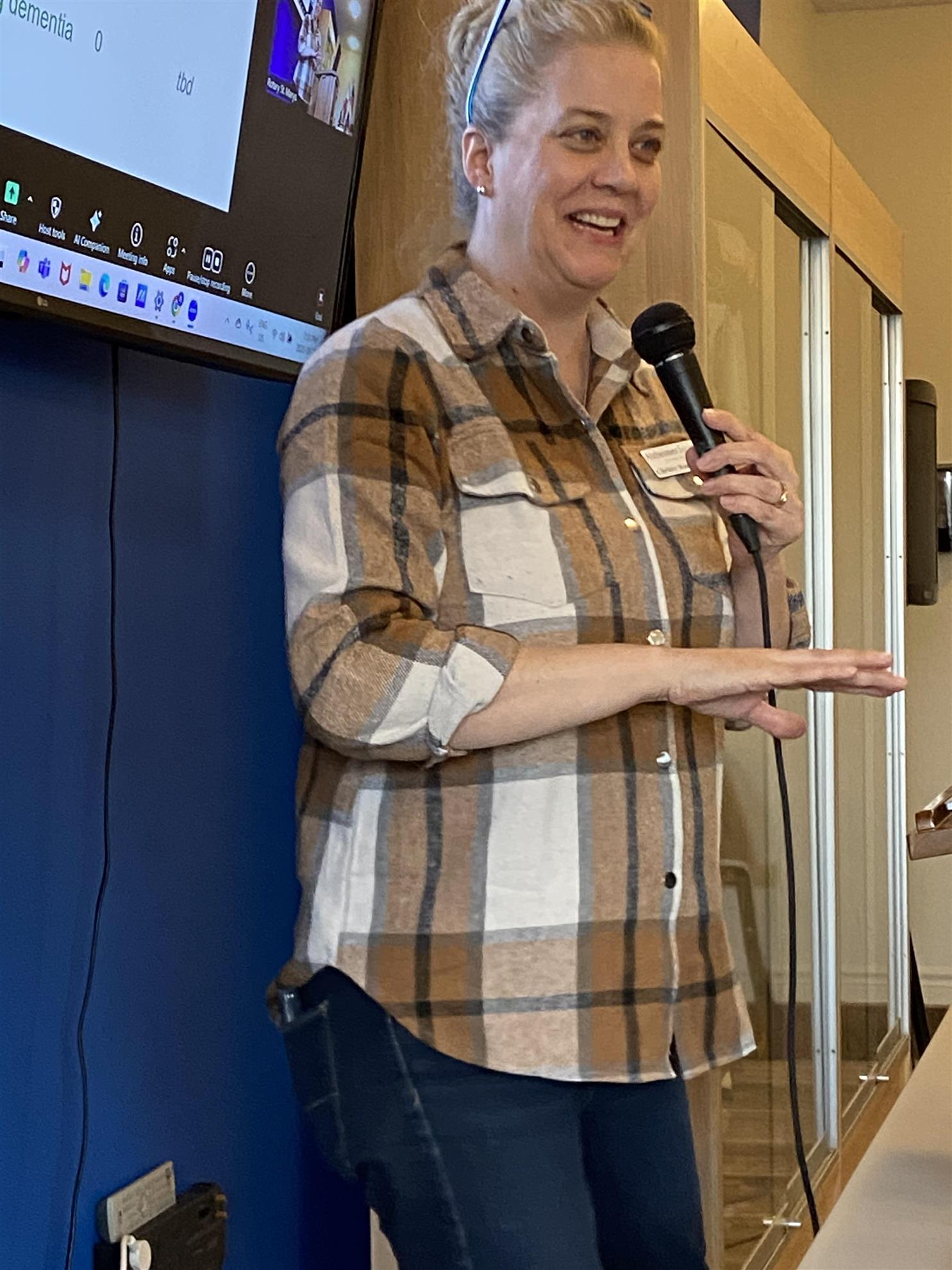
Presenter: Christy Bannerman
Organization: Alzheimer Society of Perth County
Role: Public Education Coordinator; former crisis mental health counsellor with 20+ years of experience.
Presentation Overview
Christy Bannerman shared insights on dementia and Alzheimer’s disease, aiming to increase awareness and foster more dementia-friendly communities. Her talk covered the definitions, prevalence, symptoms, safety issues, and strategies for effective communication and support.
Key Points Covered
1. What is Dementia?
Dementia is an umbrella term for a group of symptoms affecting cognitive function.
Alzheimer’s disease is the most common type, accounting for 60–80% of cases.
Other forms include vascular dementia, Lewy body dementia, and frontotemporal dementia.
Dementia is progressive and currently not curable—though promising drugs are in late-stage trials.
2. Statistics
~772,000 Canadians currently live with dementia.
Expected to rise to 1.7 million by 2050.
In Ontario alone, 334,000 cases are expected to rise to 750,000 by 2050.
Despite rising numbers, prevalence (percent affected) is slightly declining due to improved health awareness.
Early Signs & Symptoms
Christy outlined 10 early signs of dementia, including:
Memory loss
Changes in mood or personality
Language and communication difficulties
Poor judgment
Disorientation in time and place
Trouble with familiar tasks
Misplacing items often
Decreased initiative
She stressed that symptoms go beyond memory loss—they affect behavior, reasoning, and day-to-day functioning.
Commonly Misdiagnosed/Treatable Conditions
Before assuming dementia, Christy noted other conditions can mimic symptoms:
Medication side effects
Vision or hearing loss
Vitamin deficiencies
Delirium
Sleep disorders
Thyroid issues
Thorough medical evaluation is essential for proper diagnosis.
Safety Concerns
4 in 10 people with dementia go missing at some point.
Average time lost: 4.5 hours
Average distance wandered: 8.9 km
Some individuals may not recognize they are lost, making community awareness critical.
Tools & Resources:
Medical alert bracelets with blue symbols indicating cognitive conditions.
Project Lifesaver: A radio tracking system supported by Stratford Police.
Emergency information forms (e.g., Huron Perth EMS fridge forms).
"Finding Your Way" kits for missing persons preparedness.
How to Support People with Dementia
Christy emphasized 3 practical approaches:
Offer appropriate help – kind, non-patronizing assistance.
Enhance communication:
Use simple, clear language.
Repeat using the same words—not louder or differently.
Be aware of tone, body language, and emotional cues.
Support their reality:
Avoid correcting false beliefs that may cause distress (e.g., saying a deceased relative is “busy” rather than reminding them of their death).
Use empathy over confrontation: "Connect, don’t correct."
Alzheimer Society Services
Christy outlined 3 core pillars of service:
Counselling – for those diagnosed or experiencing cognitive change, and their families.
Education – both public and client-specific programs.
Social recreation – community-based and in-home programs to reduce isolation and promote mental stimulation.
Christy closed by encouraging attendees to promote dementia-friendly attitudes in their communities and thanked the Rotary Club for being an excellent example of a welcoming, supportive organization.